
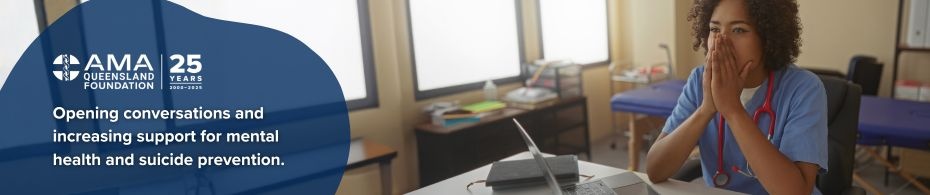
Under pressure: the quiet crisis affecting healthcare professionals.
Success! Your request has been sent and a representative will be in contact soon.
Every day in hospitals and practices across Queensland, doctors come face to face with patients seeking help for mental ill health, or those who are experiencing suicidal ideation. Often on the frontline providing immediate support and direction to services, what doctors may tell you is that the issues surrounding mental ill-health and suicide are incredibly complicated, and risk factors often compound for many underserved and vulnerable individuals.
The prevalence is widespread, with one in two Australians experiencing mental ill-health in their lifetime and on average, two Queenslanders take their own lives each day.
What doctors may not tell you is that they themselves can be at increased risk, particularly practitioners in their training years.
A study published earlier this year in the Australian and New Zealand Journal of Psychiatry examined the relative risk of suicide among healthcare professionals compared to other occupations. The study showed an increased risk of 1.3 times the national average. The study concluded:
“There has been a substantial increase in the risk of suicide among female medical practitioners with rates of suicide in this group more than doubling over the last two decades. Findings highlight the need for targeted suicide prevention initiatives for healthcare professionals.”
These findings were echoed in recent data just released by the ABS for 2023-24, which showed that female health professionals were the occupation sub-group with highest rates of suicide in females, accounting for 164 deaths last year.
While this figure encompasses a wider umbrella than just doctors, it does highlight a need to understand more about the experience of health professionals when it comes to these pressing issues.
 As part of our ongoing awareness and fundraising campaign for mental health and suicide prevention this Christmas, the Foundation reached out to Dr Emma Hodge to gain insight into these challenges. Dr Hodge is Chair of AMA Queensland Committee of Doctors in Training, as well as being the Medical Education and Wellbeing Registrar at Bundaberg Hospital.
Dr Hodge has also been involved in the AMA Queensland-ASMOFQ (Australian Salaried Medical Officers’ Federation Queensland) Resident Hospital Health Check – an annual survey of junior doctors which provides a platform for anonymous feedback on hours of work, career support, workplace culture, educational opportunities, and wellbeing in Queensland’s hospitals.
Junior doctors are facing a ‘perfect storm’ of challenges
For junior doctors, Dr Hodge said a combined set of systemic, cultural, and personal pressures can intensify stress and increase the risk of developing poor mental health.
“Long hours, limited staffing, unpredictable rosters and the constant exposure to distressing patient situations and trauma can contribute to stress and burnout,” she said.
“In junior doctors particularly, this compounds with often high expectations alongside pressure to get into specialty training, limited control of their work conditions and also fear of reputational damage if they speak up,” she said.
Dr Hodge said that competition for specialist training positions can see junior doctors going “above and beyond” to secure a place.
“As a junior doctor, you often have to undertake research, postgraduate or master’s courses, or other points of difference, to try and get into a training program in addition to your generally very stressful job,” she said.
Due to the rotational nature of the job, Dr Hodge said junior doctors can also lose important support systems that help them weather additional stress.
“I know personally my support network is spread out across Queensland because all of my friends from medical school have gone everywhere and we're constantly rotating until we get our fellowship and are able to get a permanent job.”
“It can also be quite hard to have access to good support networks locally, particularly when we are sent to rural areas where there can sometimes be less support services around and that can compound the isolation associated with an already stressful job,” she said.
For those working in a small town, the options for support often decrease even further.
“If you work in a small town, then you might have to go and see a doctor who is your colleague. So that can deter people from seeking help,” she said.
Fear of speaking up about issues
When it comes to speaking up about pressures or problems, Dr Hodge said junior doctors can be reluctant to provide feedback around adverse situations or poor supervision due to fear of retribution.
“I think there's a lot of fear from a junior doctor perspective around speaking up, particularly when you're trying to get into specialist training programs, because you don't want to be seen as a ‘difficult’ individual or you don't want to be necessarily providing negative feedback about someone who might have to be a referee for you to apply to a specialty training college.”
“This can create a situation where there is a tendency to not provide feedback around adverse situations or other workplace challenges,” she said.
Alongside a fear of retribution within the hospital exists the pervading idea that doctors should not experience issues in the first place.
“There’s this idea that we’re all capable, highly educated individuals that should just be able to fix our own well-being and we shouldn't have any issues because that reflects poorly on us or makes us look weak, which is really not the case,” she said.
“Now we’re recognising that doctors experience burnout and psychological distress not because they lack coping skills, but because the system really expects us to operate in unsustainable conditions.”
When it comes to experiencing mental health challenges, doctors of all ages can also be fearful of the impact that speaking up may have on their Ahpra registration.
“There’s a misconception that if you have a mental illness, you could get reported to Ahpra which is not the case, but a lot of doctors across all levels hold this belief that if they go and seek help, maybe someone might report them.”
Dr Hodge said Australian mandatory reporting rules are quite reasonable.
“As long as you are looking after yourself, seeking appropriate supports, and there is no risk to patient safety, then there is no need to report mental ill-health to the medical board,” she said.
Multi-faceted support will make a difference
Dr Hodge said there is room for improvement in multiple areas to help address the issues.
“If we were thinking big picture, more resources and staffing in the hospital system would make the biggest difference. That would relieve the pressure on individual practitioners to work the hours and the workload that we currently do because the public system is overwhelmed with patient presentations and workload relative to the staffing that we have,” she said.
Individual support can also help the experience of junior doctors.
“It's about supporting access to services such as Doctors Health in Queensland or having those dedicated well-being resources within the hospital system that can support doctors to operate in those busy conditions.”
“Also making sure there's really good linkages with local GPs who will prioritise seeing other doctors,” she said.
Dr Hodge’s dream would be to have a dedicated well-being registrar similar to that in Bundaberg within every hospital in Queensland.
“I think it's been a really useful initiative in my current health service where you've actually got a dedicated medical officer to look at what issues are impacting doctors’ wellbeing within the health service, what sort of things we can do to improve it,” she said.
The other way Dr Hodge said we can affect change is on a cultural level, reducing stigma, and reframing the way we see mental health challenges in the medical profession.
“We know that mental health is just as important as physical health. So even though it's not visible, we do need to treat it the same,” she said.
She suggests that mental ill-health should not be seen as a personal failure, but an occupational hazard.
“In the same way that we need to get a lot of immunisations to protect us from communicable diseases as part of our job, we need to have really good wellbeing supports in our personal and professional lives to buffer against the occupational hazard of psychological distress in a workplace.
“Also, I think having visibility of the issue is really important. So having people speak up about lived experience of mental illness and normalising health seeking behaviour, I think, debunking myths around mandatory reporting and then also having clear pathways to seek support and access services.”
24-hour support
If any of the topics in this article have raised issues for you, help is available. Here’s where you can find 24/7 support.
Beyond Blue 1300 22 4636
Lifeline 13 11 14

Let’s join together to increase support
Whether practitioner or patient, colleague, neighbour, friend or family, so many in our community have had personal experience with mental health challenges. And too many of us can think of someone we lost to suicide.
If you are looking to make a meaningful and tangible difference towards this cause, we urge you to consider donating to the Foundation Christmas appeal. With your help, the Foundation can increase support for services that provide lifesaving help to those around us right here in Queensland.